Dealing with difficult people gets easier when you understand WHY they push your buttons, at the Thanksgiving table and in the conference room.
Dealing with difficult people is never more of a challenge than on Thanksgiving. Picture it. The turkey is perfect. The table looks like a magazine cover. Everyone sits down, someone says grace, and then Uncle Bob clears his throat and says, “So… did anybody see the news this week?”
And there it goes.
I’ve always said life would be easy if it weren’t for other people. It’s even the name of one of my keynote programs and one of my books. And there’s no day of the year that proves it quite like Thanksgiving.
You’re not alone if you’re bracing yourself. In an American Psychological Association survey conducted by The Harris Poll, 72% of U.S. adults said they hoped to avoid talking politics with family over the holidays, and 38% said they were avoiding relatives they disagree with altogether.
Here’s the good news. As a former licensed therapist, I can tell you that dealing with difficult people is a skill, not a personality trait. And the same skills that get you through dinner with your family will make you a better leader, teammate and communicator on Monday morning.
Why do some people push our buttons?
People push our buttons because their behavior is meeting a need, usually a need to feel heard, important, in control or appreciated. It’s rarely about you. Holidays make it worse because families slip back into old roles. Once you see the need behind the behavior, you can respond to it instead of reacting.
Here’s something I learned in my years as a therapist: nobody wakes up on Thanksgiving morning planning to ruin dinner.
They do what they do because, at some point, it worked for them. Arguing got them attention. Criticizing made them feel in control. Complaining got them help.
And families are the ultimate time machine. You can be a CEO with 500 employees, and within ten minutes of walking into your mother’s kitchen, you’re 14 years old again. Everyone slides right back into the role they’ve always played.
The same thing happens at work. Under pressure, people fall back on whatever behavior has protected them in the past. The difference between being frustrated and being effective is understanding WHY.
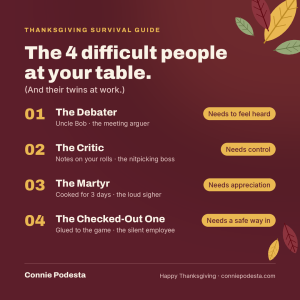
The 4 difficult people you’ll meet at Thanksgiving (and their twins at work)
Most difficult behavior falls into a few familiar patterns: the person who has to win, the person who criticizes, the person who keeps score and the person who checks out. Each one shows up at the holiday table and in the office, and each one needs something different from you.
1. The Debater
At the table: Uncle Bob, who has opinions about everything and will defend them until the pie is gone.
At work: The colleague who argues with every idea in every meeting.
What they need: To feel heard and to feel smart.
What to do: Acknowledge before you redirect. “That’s an interesting way to look at it” costs you nothing and takes the fight out of the room. You don’t have to agree. You just have to stop feeding the debate.
2. The Critic
At the table: The relative who notices your weight, your job, your parenting and the fact that you brought store-bought rolls.
At work: The boss who only comments when something goes wrong.
What they need: Usually control, and sometimes reassurance that they still matter.
What to do: Don’t defend, explain or justify. A calm, cheerful “Thanks, I’ll think about that” ends the conversation faster than any argument ever will.
3. The Martyr
At the table: The one who cooked for three days and wants everyone to know nobody helped.
At work: The teammate who sighs loudly and reminds everyone how much is on their plate.
What they need: Appreciation.
What to do: Give it, specifically and out loud. “This stuffing is incredible. How long did it take you?” Most martyrs aren’t looking for help. They’re looking to be noticed.
4. The Checked-Out One
At the table: The cousin on their phone, or the brother-in-law who disappears into the football game.
At work: The disengaged employee who does the minimum and says nothing in meetings.
What they need: A reason to engage that feels safe.
What to do: Invite them in with a question they can’t get wrong. “You always find the best restaurants. Where should we go next time?” People engage when they feel valued, not when they feel cornered.
Want to understand the personalities in your life (including your own) even better? Take my free Personality Shapes assessment.
How do you handle difficult family members without starting a fight?
Decide how you’ll respond before you arrive, don’t take the bait, ask questions instead of making points and have an exit line ready. You can’t control what anyone else says at the table. You can only control your reaction, and that’s where all your power is.
Here are five strategies I’ve taught to audiences for decades. They work just as well over turkey as they do in a team meeting.
Decide before you walk in the door
You already know who’s going to say what. So decide now how you’ll respond. When you’ve made the decision in advance, you’re not reacting in the moment. You’re following your plan.
You don’t have to attend every argument you’re invited to
Someone tosses out the bait. You don’t have to bite. Smile, pass the potatoes and change the subject. Not engaging is not losing. It’s choosing.
Ask a question instead of making a point
“What makes you feel so strongly about that?” changes the entire temperature of a conversation. People soften when they feel curious attention instead of opposition. And honestly, you might learn something.
Respond to the need, not the behavior
Once you know what someone needs (to be heard, appreciated, in control or included), give them a little of it. It’s amazing how quickly difficult behavior fades when the need behind it is met.
Have an exit line ready
“I’m going to go check on the pie.” “Let’s take a walk before dessert.” Leaving a conversation that’s going nowhere isn’t rude. It’s smart. Every great leader knows when to stop talking.
What can Thanksgiving teach leaders about difficult people at work?
Thanksgiving is a crash course in the psychology of leadership. Leaders deal with the same debaters, critics, martyrs and checked-out people every week. The leaders who stay calm, understand what people need and choose their response instead of reacting build teams that trust them.
Here’s what I tell leaders all the time: you don’t get to choose your family, and most of the time you don’t get to choose your team either.
But you do get to choose how you lead them.
The manager who can stay calm when a meeting gets heated, who can find out what the chronic complainer really needs and who can bring a disengaged employee back into the conversation is the manager people want to work for.
And it all starts with the way you think. When you stop asking “Why are they like this?” and start asking “What do they need?”, everything changes. At the dinner table and at work.
Dealing with Difficult People FAQ
Why are family members so difficult during the holidays?
Holidays bring together people with long histories, high expectations and very little sleep. Families also fall back into old roles, so adults start reacting the way they did as kids. Add travel, money stress and politics, and even loving families can get tense.
How do I stay calm when someone pushes my buttons?
Decide in advance how you’ll respond, take a breath before you speak and remember that their behavior is about their needs, not your worth. You can’t control what they say. You can always control what you say next.
Is it OK to avoid a difficult conversation?
Yes. Not every conversation needs to happen at the Thanksgiving table. Choosing a better time and place is a smart decision, not a weakness. The goal is a relationship that works, not winning one argument.
Do the same strategies for dealing with difficult people work at the office?”
Absolutely. Debaters, critics, martyrs and checked-out people exist in every organization. Understanding what each one needs, and responding to that need, works in the office exactly the way it works at home.
Contact Me Today
This Thanksgiving, I’m grateful for every leader and team I’ve had the privilege of working with, difficult people and all. If you want your people to communicate better, handle conflict with confidence and laugh a whole lot more along the way, let’s talk.
Contact Me Today or email me at connie@conniepodesta.com.
Happy Thanksgiving!