

To challenge the status quo, you don’t need one giant idea. Here are 7 ways great leaders make innovation an everyday team habit.
Let’s be honest. When most leaders hear the word innovation, they picture something enormous. A moonshot. A billion-dollar breakthrough. Some outrageous, never-been-done, wildly complicated idea dreamed up by a genius in a hoodie, not a simple challenge of the status quo.
Not intimidating at all, right?
In my years of working with leaders across just about every industry, I’ve watched this belief quietly stall entire organizations. Because if innovation is that big, it’s easy to decide it’s not your job today. You’ve got deadlines. Budgets. People problems. So you coast on “business as usual” and wait for the lightning bolt to strike.
And while you wait? The status quo becomes perfectly acceptable.
Here’s the truth: to challenge the status quo isn’t about one giant idea. It’s a daily leadership habit. It starts in the leader’s mindset and spills into every person on the team. Get that right, and innovation stops being an event and starts being how your team works.
The Hidden Cost of Accepting the Status Quo
The status quo feels safe. That’s exactly what makes it dangerous.
Psychologists even have a name for it: status quo bias, our natural tendency to prefer things the way they are, simply because that’s how they are. Economists William Samuelson and Richard Zeckhauser named it in a 1988 study showing that people disproportionately stick with what they already have. Change feels like risk. Staying put feels like stability. But in business, standing still is just falling behind slowly.
Here’s what “business as usual” really costs you:
- Your best people get bored. Top performers want to grow. When every idea is met with “that’s how we’ve always done it,” they stop offering ideas. Then they stop caring. Then they leave.
- Your competitors don’t wait. While you’re waiting for the big breakthrough, someone else is making a hundred small improvements to win your customers.
- Small problems become big ones. The clunky process, the outdated tool, the meeting nobody needs. Left alone, they compound into real drag on morale and results.
- Your culture learns to stay quiet. Every time a leader shrugs off a suggestion, the team learns a lesson: don’t bother.
The status quo isn’t neutral. It’s a decision, and usually a costly one.
Innovation Is a Mindset, Not a Lightning Bolt
Great leaders don’t wait for the light-bulb moment. They build teams that find light bulbs everywhere.
The secret? They stop asking “What’s the next big thing?” and start asking “What could be better?” That one shift changes everything. Suddenly innovation isn’t reserved for the R&D department or the annual off-site. It belongs to everyone.
Think about the products, services and processes you already have. Could they be:
- Faster or easier?
- Smarter or more affordable?
- Less stressful for your customers or your team?
- More efficient, more personal, more profitable?
That’s innovation. Not brand-spankin’-new. Just better, again and again. Businesses often call this continuous improvement, and the leaders who master it build a culture of innovation without ever announcing one.
When you re-frame innovation as an everyday quest instead of an occasional, caffeine-fueled brainstorming session, your team starts looking for better options instinctively. In every meeting. Every project. Every customer conversation.
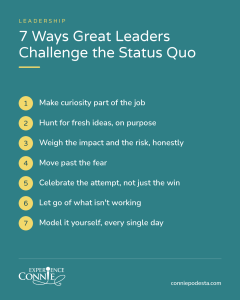
7 Ways Great Leaders Challenge the Status Quo
Want to know how to encourage innovation in the workplace without blowing up your business? Start here.
1. Make curiosity part of the job
Great leaders consistently inspire curiosity, and then they reward it. Don’t just say “my door is always open.” Build it into the rhythm of your week. Ask for one improvement idea in every team meeting. Make “What would make this better?” a standard question, not a special occasion.
2. Be methodical about hunting for fresh ideas
Innovation doesn’t happen by accident. Pick one area each month (onboarding, customer follow-up, reporting, whatever) and ask the team to pick it apart. Where’s the friction? What’s slow? What do customers complain about? Hidden opportunities are everywhere once you’re actually looking.
3. Assess the impact and the risk, honestly
Not every idea deserves a green light. Smart leaders weigh the potential upside against the real risks before acting. What will it cost? Who does it affect? What happens if it fails? This isn’t about killing ideas. It’s about choosing the right ones so your team trusts the process.
4. Move past the fear
Here’s where most leaders get stuck. They see a good idea, they know it makes business sense, and they still don’t act. Fear of failure, fear of looking foolish, fear of upsetting the apple cart. If the numbers and the logic say go, go. Courage is a leadership skill. (If change makes you or your team nervous, here’s how to navigate change with resilience and a little humor.)
5. Celebrate the attempt, not just the win
If your team only gets praised for home runs, they’ll stop swinging. Recognize the people who spotted a problem, tested a fix or raised a tough question, even when it didn’t pan out. What gets rewarded gets repeated.
6. Let go of what isn’t working
Some of the biggest innovations aren’t additions. They’re subtractions. The report nobody reads. The approval step that slows everything down. The “tradition” that no longer serves anyone. It takes real mental discipline to recognize what’s not working and let it go.
7. Model it yourself, every single day
Your team is watching you. If you resist change, they will too. If you ask questions, admit what you don’t know and try new approaches out loud, you give everyone permission to do the same. Make innovative thinking your standard operating procedure, and it becomes theirs.
5 Questions to Ask Your Team This Week
You don’t need a strategy retreat to start. Bring one of these to your next meeting and watch what happens:
- What’s one thing we do every week that wastes your time?
- If you were our customer, what would frustrate you most about working with us?
- What’s a process we follow only because “that’s how we’ve always done it”?
- If we had to cut the time on this project in half, what would we change?
- What idea have you been sitting on because you weren’t sure anyone would listen?
That last one? That’s where the gold is.
Pro tip: When someone answers, your first response matters more than you think. Say “Tell me more” before you say “But.”
The Psychology Behind Leaders Who Thrive
The connection is clear. Leaders who understand the psychology of leadership and of achieving goals with and through their people are far more likely to exceed expectations.
The quality of your relationships directly shapes the quality of your business decisions. When your team trusts you, they tell you the truth. When they tell you the truth, you find the opportunities everyone else misses.
And it all starts with the way you think.
To thrive at the highest level, you have to recognize what’s not working and have the mental discipline to let it go. Strengthen that mindset, and you don’t just change your results. You change what your entire team believes is possible.
So quit waiting for the lightning bolt. Quit accepting the status quo. Start asking “What could be better?” today.
Want to build a team that innovates every single day? Connie Podesta’s keynotes give leaders the mindset and practical strategies to challenge the status quo, strengthen relationships and drive real results. Book Connie for your next event or explore her keynote topics.
Frequently Asked Questions
What does it mean to challenge the status quo in leadership?
It means refusing to accept “that’s how we’ve always done it” as a reason. Leaders who challenge the status quo regularly question existing processes, products and habits, and push their teams to find better, faster or smarter ways to work.
Why do leaders accept the status quo?
Mostly because change feels risky and daily demands leave little room to think ahead. Status quo bias, our natural preference for what’s familiar, makes “business as usual” feel safer than it really is.
How can leaders encourage innovation in the workplace?
Make curiosity part of the job, ask for improvement ideas regularly, reward attempts as well as wins, assess ideas honestly and model innovative thinking yourself. Innovation grows when it’s an everyday habit, not a once-a-year event.
Is innovation only about new ideas?
No. Most innovation is improving what already exists: making a product, service or process easier, faster, more affordable or less stressful. Small, continuous improvements often beat one big breakthrough.
Ready to Quit Accepting the Status Quo?
Your team has the ideas. They’re just waiting for a leader who asks. I’ve spent decades helping leaders spark curiosity, push past fear and turn “business as usual” into everyday innovation, with real psychology and plenty of laughs.
Let’s talk about your next event, and I’ll give your leaders the mindset to challenge the status quo for good.
Not ready to book yet? Join the Connie Connection and I’ll send you my award-winning ebook, StandOut Leadership, free.