
Customers rarely say no because of price. They say no because they didn’t connect. Learn to read bottom-line vs. relationship buyers and adapt fast.
Most lost sales don’t come down to price or the market. They come down to a communication mismatch. Here’s how to adapt your selling style to the buyer in front of you.
80% of my audiences? SALES. After more than 35 years working with top sales organizations around the globe, I’ve heard just about every success story, and every reason money gets left on the table. Here’s what I know.
Why do salespeople really lose deals?
Most deals are lost because the customer didn’t connect with the salesperson, not because of price.
Ask salespeople why a deal fell through and you’ll hear: price, product, the economy, marketing, territory. Ask customers and you’ll hear something very different: “I just didn’t connect with the salesperson.”
The research backs this up. In a Harvard Business Review study of more than 230 B2B buyers, one of the top reasons salespeople failed to close was that they couldn’t build a personal connection. Among the causes buyers named: the salesperson’s personality was very different from their own.
So here’s a question worth asking: Could I be getting in my own way? The biggest lever you have in sales is your ability to recognize the selling style your customer relates to best.
Who should adapt in a sale: the salesperson or the customer?
The salesperson. Always.
If someone is going to feel a little uncomfortable in the sales process, it should NEVER be the customer. Great salespeople are the ones willing to flex and change things up to build the kind of trust that closes deals. THAT’S the sweet spot in the sales business.
Is your ego helping or hurting your sales?
Both, and knowing the difference is what separates good salespeople from great ones.
Instead of looking for outside reasons, ask yourself: “Is there something about my selling style that doesn’t fit this buyer’s personality and comfort zone?” Odds are, that’s what’s standing between you and even higher sales.
You need a healthy dose of ego to succeed in sales. Ego fuels the confidence, charm, credibility, and charisma it takes to turn a NO into a YES. But ego can also slip us into “all about me” mode instead of “all about the customer,” and that’s where the trouble starts.
Selling is never about the salesperson. It’s about the customer, the member, the client. Your job is to create an atmosphere where they feel comfortable enough to believe in you, trust you, and buy. So before you charge in with your own go-to style, notice how they like to receive information. Then adjust. Quickly.
How do you sell to different personality types?
Start by figuring out which of two types your buyer is (bottom-line or relationship) and then match your approach to theirs. Let me simplify a complex subject and take you inside the mind of the typical buyer.
Bottom-line buyers want numbers, statistics, and hard facts. They aren’t looking for small talk or a new friend. They want to know you know your stuff and can handle any question or problem that comes up.
Relationship buyers want to get to know you and, yes, LIKE you before they’ll even think about signing on the dotted line. For them, small talk isn’t small at all. It’s an interview to decide whether you’re the right person for them. If you see chit-chat as a waste of time, you’re leaving a lot of money on the table.
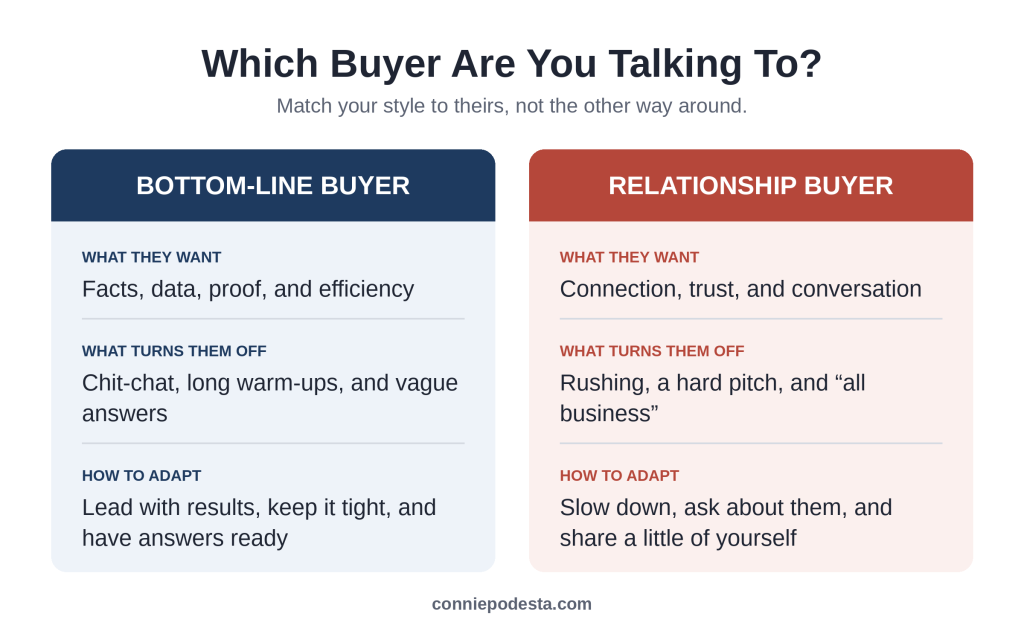
Here’s where the mismatch happens. If you’re a bottom-line salesperson, your relationship buyers may see you as hurried, cold, or all about the money. If you’re a relationship salesperson, your bottom-line buyers may tune out during the friendly chatter and wonder when you’ll get to the point.
How can you tell which type of buyer you’re talking to?
Listen first, talk second. Most salespeople do it the other way around.
Tune in to the person in front of you and set your own filter (your ego) aside for a moment. A few clues to watch for in the first few minutes:
- They skip the small talk and ask about price, specs, or timelines. Likely bottom-line.
- They ask about you, share stories, or linger on the personal stuff. Likely relationship.
- Their emails are short and to the point (bottom-line) or warm and chatty (relationship).
If you can read that within the first few minutes, and adapt to them instead of expecting them to adapt to you, your odds of landing the sale go way up.
Frequently asked questions
What is the main reason customers don’t buy? Customers most often say they didn’t connect with the salesperson. Price and product get the blame, but a mismatch in communication style is frequently the real issue.
What are the two main types of buyers? Bottom-line buyers, who want facts and efficiency, and relationship buyers, who need to know and like you before they buy.
How do you adapt your sales style to a customer? Identify the buyer’s style in the first few minutes, then match it: lead with data and brevity for bottom-line buyers, and slow down and build rapport with relationship buyers.
Does ego help or hurt salespeople? Both. Ego fuels confidence and charisma, but it hurts when it shifts the focus from the customer to the salesperson.
Your next step
This is exactly what I love teaching sales audiences: how to size up the people in the room within minutes and know the right approach to help each customer feel safe enough to like you, trust you, and do business with you. That’s how you stop leaving money on the table and start building long-term business and referral relationships.
That’s the goal, right? So starting today: no more excuses!
Here’s a quick video I did on the topic!
If you’d like to learn more about closing more sales and building a stronger business, book me to come in and take your sales team to the next level! It will be fun, dynamic – and a big boost to your bottom line productivity!